


Under tariff rationalisation plan current five-tier CD structure will be simplified to just four slabs: 0%, 5%, 10%, and 15%
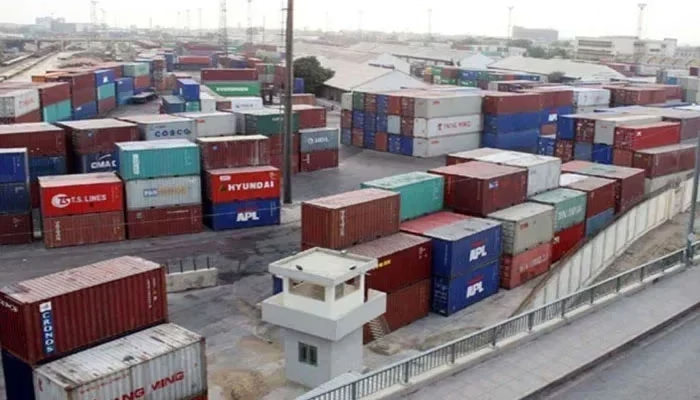
ISLAMABAD: In a bold shift toward export-led growth, Pakistan will cut its average tariff rate from 20.19pc to just 9.7pc over the next five years, eliminate regulatory duties, and phase out additional customs duties by 2029 under the draft National Tariff Policy 2025–30, officials told a parliamentary panel on Wednesday.
Under the tariff rationalization plan, the current five-tier customs duty (CD) structure will be simplified to just four slabs: 0pc, 5pc, 10pc, and 15pc. The CD would be reduced to the maximum of 15 per cent in five years. The outdated 5th Schedule will also be scrappedThe reforms are part of the newly introduced National Tariff Policy 2025–30, which aims to boost export-led growth and create jobs. The policy was explained by the Commerce Ministry, the Finance Ministry and the Federal Board of Revenue during a briefing to the National Assembly’s Standing Committee on Finance and Revenue on Wednesday.
The sweeping reforms aim to make imports cheaper, push local industries to compete globally, and shift the economy away from import-driven consumption that has fueled balance of payment crises.
Government will gradually reduce overall average tariffs from the current 20.19pc to 9.7pc by 2030 under the policy, officials told the parliamentary finance panel. In the first year, average tariffs will be cut to 15.65pc, followed by annual reductions to 13pc, 11.5pc, and 10.25pc, reaching 9.7pc by the final year (2030).
The average customs duty (CD), currently at 11.93pc, will be brought down to 11.18pc in the first year, followed by 11pc, 10.5pc, 10pc, and ultimately 9.7pc by 2030. Additional customs duty (ACD) will be reduced from the current average of 3.66pc to 1.76pc in the first year, 1pc in the second, 0.5pc in the third, and completely eliminated by the fourth and fifth years.
Similarly, regulatory duty (RD) will be slashed from 4.6pc to 2.71pc in the first year, 1pc in the second, 0.5pc in the third, 0.25pc in the fourth, and eliminated entirely by 2030.
“High tariffs are our biggest barrier,” said Commerce Secretary Jawad Paul. Pakistan’s past free trade agreements (FTAs) failed to yield positive results, “We have been protecting local industries for last 40 years—it’s time to open up.”
Some local manufacturers may feel the heat from cheaper imports, but officials say the shake-up is necessary. “Tariffs have become a protection wall,” added FBR’s Chairman Rashid Langrial.
Commerce officials cited World Bank modeling that predicts exports could rise by 10–14pc and imports by 5–6pc if the policy is fully implemented. The FBR and key stakeholders were consulted during drafting, and a cabinet-level implementation committee has been formed to ensure follow-through. Finance Minister Muhammad Aurangzeb emphasized the shift from using tariffs as a revenue tool to using them for economic reform. “In the past, we used tariffs to solve balance of payments issues,” he said. “Now, we’re using them to boost competitiveness.”
Still, concerns remain. NA Finance Committee Chairman Syed Naveed Qamar questioned whether the next government will stay the course. The Commerce Secretary responded confidently: “This policy, like the last one, is built to last five years.” The committee debated enforcement steps to curb Pakistan’s Rs300 billion tax loss from untaxed cigarettes, rejecting police action in favor of excise and revenue officials. The FBR said the losses include counterfeit local brands and reported a drop in tyers smuggling, with more anti-smuggling measures on the way.