
But as ever with Trump, there’s a question as to whether he’s serious with his threats or is staking out an extreme position to please his voters or even to create some perceived leverage for himself.
Homan, for instance, told CNN’s Collins that Newsom had “absolutely not” done anything at this point to justify his arrest.
And North Dakota Republican Sen. Kevin Cramer adopted the classic GOP line that not everything that the president says should be taken literally when asked about administration threats to detain Newsom. “You guys could ask every day if I am comfortable with what he said. He hasn’t arrested him. I can’t imagine that he is going to arrest Gavin Newsom,” Cramer told CNN’s Manu Raju.
Cramer also voiced the view of many Republicans that, far from behaving like an authoritarian, Trump is rightfully addressing failures by Democratic leaders on immigration policy and public order. “There’s no question about it: Places like California have thumbed their noses at the American people and decided they want to be sanctuary for criminals,” Cramer said.
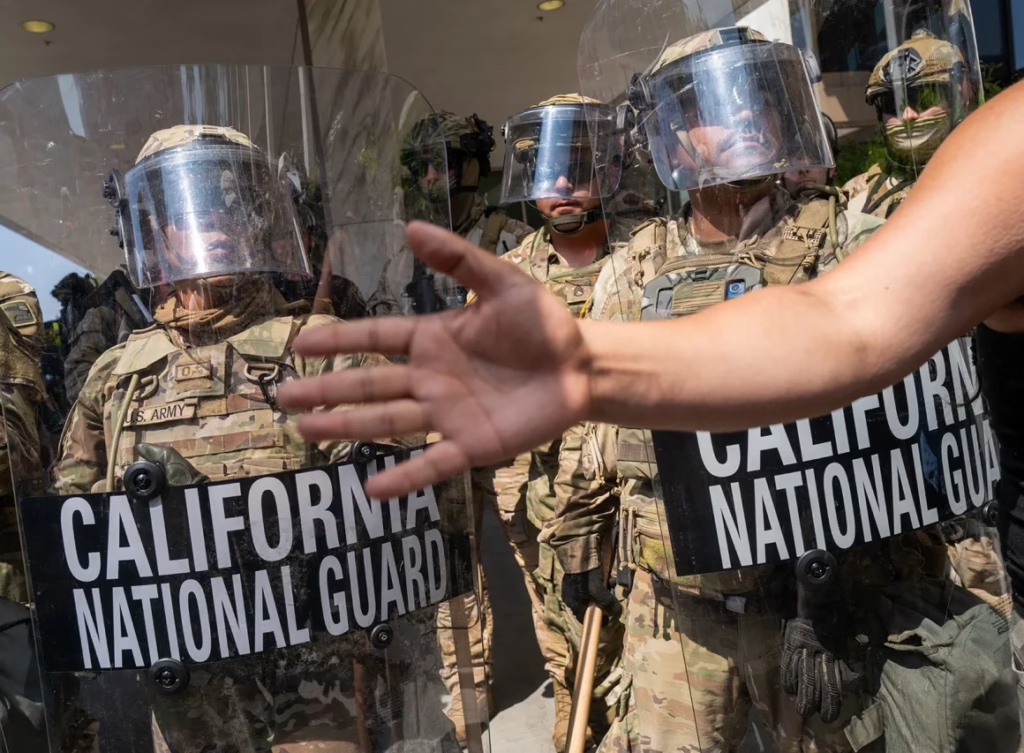
So far, National Guard reservists mobilized by the president over the head of a state governor for the first time since the Civil Rights era in the 1960s have mostly been used to defend federal buildings in Los Angeles. While the announcement of a deployment of Marines to the city was superficially alarming, their orders prohibit them from conducting law enforcement activities like making arrests without Trump invoking the Insurrection Act. The Marines are expected to be used to bolster National Guard members on the ground while up to 2,000 reservists are mobilized.
CNN’s Evan Perez, meanwhile, reported on Monday evening that while officials like top White House aide Stephen Miller have been talking about an “insurrection,” administration lawyers have been working to craft a much less confrontational way of protecting the federal government’s ability to carry out immigration enforcement, hoping to avoid further inflaming the situation, according to multiple people briefed on the discussions.
This may all signify that the president is not yet ready to push the nation toward an unprecedented authoritarian cliff — even if his personal history, not least over January 6, 2021, suggests that in the heat of the moment he often takes the most reckless course.
And Trump may be playing with fire in a city and state where anger over his wild four-month-old presidency is boiling. By inserting troops into such a volatile and tense environment, he’s opening the possibility that flashpoints could ignite and even that tragic circumstances could unfold.
But then again, maybe that’s the point, if the president is seeking a predicate to deploy active-duty troops on the streets of American cities.
Another troubling omen is that Newsom — who, like Trump, relishes public fights — has no incentive to cave to the man he would like to replace as president in 2029.
Newsom, for example, wrote on social media on Monday that the president was deploying another 2,000 National Guard troops to Los Angeles, even though only 300 from his initial 2,000-strong contingent had so far arrived in the city. “This isn’t about public safety. It’s about stroking a dangerous President’s ego,” the governor said. “This is Reckless. Pointless. And Disrespectful to our troops.”
The state has sued the administration over that initial call-up of reservists. State Attorney General Rob Bonta called Trump’s federalization of the state’s National Guard troops “unnecessary, counterproductive, and most importantly, unlawful.”
The suit created yet another legal morass around one of Trump’s most aggressive power grabs. California has now lodged 24 lawsuits against the administration in 19 weeks.
With every day that passes in the California public order crisis, the political incentives seem to be driving toward more confrontation rather than a peaceful resolution.
But ultimately it’s up to Trump how this ends.