




Every confrontation has the potential to escalate into a larger conflict, especially as both countries are involved in cyber-attacks, naval sabotage, and intelligence operations
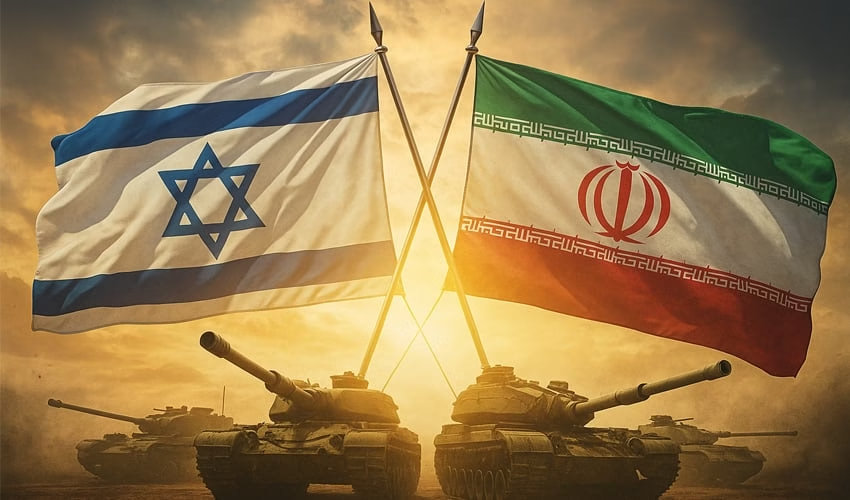
Israel and Iran are on the brink of a war. Still, there is hope for a peaceful resolution of the conflict between the two countries.
During years of ideological competition, proxy battles, and nuclear threats, the Israel-Iran conflict continues to be a highly risky situation in the Middle East. It is one of the most significant rivalries in modern geopolitics, affecting aspects like ideology, religion, regional power dynamics, and nuclear diplomacy. But the real question here is: Can peace be achieved amid the longstanding enmity between them?
It is surely not just a simple bilateral issue but a major factor contributing to instability in the Middle East that has raised concerns across the globe. As covert conflicts escalate into overt battles and diplomatic negotiations are on the brink of failure, the pressing issue is whether this strife can be resolved peacefully or if the region is headed towards another destructive war.
Former friends, now enemies
Israel and Iran were peaceful allies before the 1979 Islamic Revolution. Iran, during the rule of Shah Mohammad Reza Pahlavi, had discreet yet meaningful relations with Israel. The two worked together on trade, intelligence, and military issues, viewing each other as practical allies in a volatile area. The connection deteriorated suddenly when Ayatollah Khomeini came to power and labeled Israel as an unlawful “Zionist entity” while advocating for its eradication.
From that point on, Iran has positioned itself as the primary supporter of anti-Israel opposition, creating partnerships with non-state armed groups and advocating for the Palestinian cause through words and deeds. A profound ideological difference is the core of the conflict. Iran’s Islamic Republic, built on anti-Zionism, views Israel as an unlawful occupant of Muslim territories. Conversely, Israel perceives Iran’s leadership as determined to destroy it, a serious threat that cannot be overlooked.
At different points in time, Iranian officials have made inflammatory remarks casting doubt on Israel’s legitimacy. In Tel Aviv and Jerusalem, these statements are not viewed as mere rhetoric, but as possible indications of an upcoming conflict. One of the most pressing threats is seen in Iran’s nuclear program. Iran claims its intentions are peaceful, but Israel remains skeptical. The 2015 nuclear deal, also known as the Joint Comprehensive Plan of Action (JCPOA), was viewed as dangerously lax by Israel. Since the United States pulled out of the agreement in 2018, Iran has increased its uranium enrichment. In response, Israel has engaged in secretive sabotage missions, assassinations of nuclear specialists, and blatant warnings of potential military intervention. The global community observes the situation with anxiety.
Conflicts fought by others
From southern Lebanon to Gaza and Syria, the conflict between Israel and Iran is fought by using substitute fighters. Iran’s backing of Hezbollah, Hamas, and Palestinian Islamic Jihad has resulted in repeated border conflicts and rocket assaults. Israel, conversely, conducts regular air strikes on Iranian objectives in Syria and other locations. Every confrontation has the potential to escalate into a larger conflict, especially as both countries are involved in cyber-attacks, naval sabotage, and intelligence operations.
This dispute involves more than just two countries; it revolves around two different perspectives for the Middle East. Iran views itself as the head of an “Axis of Resistance” against Western and Israeli control. Israel, supported by the US and now more closely aligned with Arab Gulf nations, perceives Iran as the main danger to regional harmony and security. This rivalry contributes to disputes in Iraq, Yemen, and Syria, making sure that the conflict between Israel and Iran always involves more than just two countries.
Recently, there has been a shift in tactics. Israel has been blamed for killing Iranian nuclear scientists and attacking undisclosed facilities. In response, Iran, with the help of intermediaries, has increased its rocket assaults on Israeli urban areas. Tensions have escalated into the maritime domain, where unexplained assaults on oil tankers have been attributed to both parties. Conflict has also extended into the digital realm, as hackers from Israel and Iran focus on critical infrastructure. Violence frequently erupts in Gaza and southern Lebanon, where groups supported by Iran often launch rocket attacks and Israel retaliates with powerful airstrikes. Every day, the distinction between secret missions and public battles becomes less clear.
The conflict between Israel and Iran creates instability not only in their own territories but also in the entire Middle East region. Iran’s impact contributes to civil unrest and religious conflicts in Syria, Iraq, and Yemen. The military actions taken by Israel escalate tensions with Lebanon and Palestine. The constant threat of a larger conflict involving the United States, Saudi Arabia, or other nations looms overhead.
Global security and the energy market
A potential conflict between Israel and Iran, particularly in the Gulf region, has the potential to cause disruptions in global oil distribution. The Strait of Hormuz, a critical chokepoint for oil transportation, is at risk of being targeted by Iran in response. This situation could lead to increased market instability, and if not contained, could escalate into a worldwide emergency. A nuclear-armed Iran could potentially start a competition for weapons in the region. Countries in the Gulf, particularly Saudi Arabia, have stated that they will pursue nuclear weapons if Iran acquires them. The breakdown of global efforts to prevent the spread of nuclear weapons would be a disastrous outcome of uncontrolled hostility.
Even though there is violence and aggressive talk happening, there are still ways to reduce tensions. However, achieving this will necessitate courageous diplomacy, cooperation among regional powers, and strong commitment from the international community.
Broadening scope of nuclear agreement
It is crucial to have a revitalized, more durable nuclear agreement with stricter inspections and support from the region. The JCPOA should be reconsidered rather than discarded. A potential agreement would have to take into consideration the worries of Israel, potentially including discussions on missile capabilities and Iran’s backing of militias.
Creating a Security Network in the Region
The Middle East lacks a system for collective security. A forum covering the Gulf region, which would involve Israel and Iran, has the potential to encourage conversations and establish confidence. Although it may be a lofty goal, meetings and private discussions among regional leaders could form the foundation for a future security framework. Put an end to conflicts fought by one country using another as a substitute.
Prioritizing mediation efforts in Syria, Lebanon, and Gaza is crucial. Encouraging Iran to reduce its support for proxy warfare in exchange for economic incentives and improved relations should be the focus. Israel should stop causing tensions and let the local political developments in Palestine progress without constant interference.
Promoting civil conversations
People often overlook the power of people-to-people diplomacy, but it can be very impactful. Israelis and Iranians have similar cultural backgrounds and intertwined histories. Exchanges in academics, arts, and digital platforms have the potential to humanize the perceived “enemy” and foster peace from the ground up.
Diplomacy as a deterrent
If peace is not achievable at present, efforts should be made toward containment. Israel must be provided with strong security assurances, while also recognizing Iran’s valid defense worries. Diplomacy should not be viewed as a win-lose situation. The conflict between Israel and Iran is not simply a local dispute; it has global implications and is a potentially dangerous situation. However, history has shown that even the most hostile adversaries can alter their paths.
The Cold War concluded without a nuclear catastrophe. South Africa abolished apartheid. The prospect of peace in Northern Ireland was previously inconceivable. Moving forward may be challenging, but it is definitely achievable. The journey starts with using realistic diplomatic tactics, supported by collaboration with multiple countries, and guided by a vision of peaceful coexistence instead of seeking power over others.
If leaders on both sides continue to prioritize confrontation rather than compromise, the Middle East will continue to be in a state of tension. However, by opting for a different approach, even if it is gradual and not perfect, there is a possibility of preventing another disastrous war in the region.